
Understanding Vacuum Tubes: A Guide for Audio Enthusiasts
Learn about vacuum tubes in audio equipment - how they work, why audiophiles love them, and how to maintain tube-based electronics.
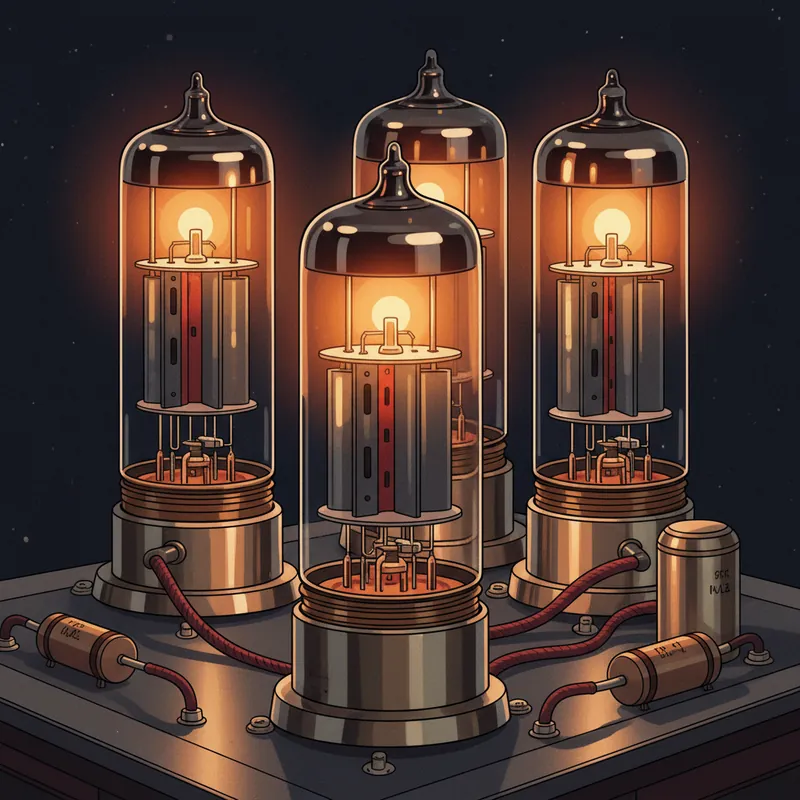
Vacuum tubes powered electronics for decades before transistors took over. Yet in audio equipment, tubes never completely disappeared. Many audiophiles insist that tube amplifiers produce a warmer, more musical sound. Whether you’re curious about vintage equipment or considering a tube amp, here’s what you need to know.
What is a Vacuum Tube?
A vacuum tube is an electronic device that controls electrical current flow in a sealed container (glass or metal) with most air removed. Inside, electrons flow from a heated cathode to an anode (plate), controlled by one or more grids.
Basic Operation
- The cathode is heated, causing it to emit electrons
- The anode (plate) has a positive voltage, attracting electrons
- Control grids between them regulate the electron flow
- Small voltage changes at the grid create large current changes at the plate
This gives tubes their amplification ability.
Common Tube Types
Power tubes (output tubes):
- EL34 - Classic British rock sound
- 6L6 - American hi-fi and guitar amps
- KT88 - High power, clean sound
- EL84 - Smaller amps, chimey tone
Preamp tubes (small signal tubes):
- 12AX7 - Most common preamp tube
- 12AT7 - Lower gain, often in phase inverters
- 12AU7 - Even lower gain, varied applications
Rectifier tubes:
- 5U4 - Common power supply rectifier
- GZ34 - European equivalent
- 5AR4 - Same as GZ34
Why Do Tubes Sound Different?
The “tube sound” debate has passionate advocates on both sides. Here’s what’s actually happening:
Harmonic Distortion
- Tubes produce even-order harmonics when distorting
- These harmonics are musically pleasing
- Solid-state produces odd-order harmonics
- Our ears perceive even harmonics as “warm”
Soft Clipping
- When overdriven, tubes compress gradually
- Solid-state clips abruptly and harshly
- Tube compression sounds natural, like dynamic limiting
- This is why tube guitar amps excel at overdrive
Circuit Design Differences
- Tube circuits often have higher output impedance
- This interacts differently with speakers
- Many tube amps run without negative feedback
- Circuit topology affects sound as much as tube vs transistor
The Placebo Effect?
Some argue the difference is psychological. Studies show:
- Trained listeners can sometimes identify tube equipment
- Expectations affect perception
- Well-designed solid-state can sound excellent
- Personal preference is legitimate
Tube Equipment Maintenance
Tube Lifespan
Tubes wear out - they’re not solid-state permanent:
- Power tubes: 2,000-5,000 hours typical
- Preamp tubes: 10,000+ hours
- Rectifier tubes: Varies widely
Signs of worn tubes:
- Reduced output power
- Increased noise or hum
- Muddy or dull sound
- Visible changes (milky, dark deposits)
Capacitor Maintenance
Often more critical than tubes:
- Electrolytic capacitors dry out over time
- Failure is common in vintage equipment
- Can cause hum, noise, or complete failure
- Should be replaced in equipment over 20-30 years old
Heat Management
Tubes run hot - that’s how they work:
- Ensure adequate ventilation
- Don’t block vents or enclose tube equipment
- Let equipment warm up before heavy use
- Allow cool-down before moving
Biasing
Power tubes need proper bias adjustment:
- Bias affects tone, output, and tube life
- Too hot = premature tube death
- Too cold = crossover distortion
- Should be checked when replacing power tubes
Buying Tube Equipment
New vs Vintage
Modern tube equipment:
- Reliable manufacturing
- Warranty and support
- Modern safety features
- Often made in China (quality varies)
Vintage tube equipment:
- Often higher build quality
- May need restoration
- Parts availability varies
- Requires more expertise to maintain
What to Look For
- Quality output transformers (expensive but essential)
- Proper ventilation
- Good component quality
- Reputable manufacturer
Tube Matching
Power tubes should be “matched”:
- Matched tubes have similar characteristics
- Creates balanced operation
- Extends tube life
- Most important for push-pull amplifiers
Safety Warning
Tube equipment contains lethal voltages. Even when unplugged, capacitors can hold dangerous charges. Unless you’re trained in high-voltage electronics:
- Don’t open tube equipment
- Don’t attempt internal repairs
- Don’t touch exposed components
- Let professionals handle internal work
Our Tube Equipment Services
We specialize in tube electronics:
- Tube testing and matching - Verify tube condition
- Bias adjustment - Optimize for your tubes
- Capacitor replacement - Essential for vintage equipment
- Full restoration - Bring vintage equipment to spec
- Troubleshooting - Diagnose problems accurately
Whether you have a vintage Fisher receiver or a modern tube guitar amp, we have the expertise to keep it running properly.
Is Tube Equipment Right for You?
Consider tubes if:
- You value warm, musical sound
- You enjoy the hobby aspect of audio
- You’re willing to maintain equipment
- You appreciate vintage technology
Stick with solid-state if:
- You want zero maintenance
- You need maximum efficiency
- You prefer precise, analytical sound
- Budget is the primary concern
Have tube equipment that needs attention? Bring it in for evaluation and we’ll help keep your tubes glowing.
Tags:
Need Professional Help?
If you've tried these troubleshooting steps and your device still isn't working, we're here to help. Bring it in for a free diagnosis - we'll figure out what's wrong and give you a clear estimate before any work begins.
Get a Free Diagnosis